
The $20 system that saved me from constantly over-editing.
How I saved myself hundreds of hours and published way more often.


The Quiet Attention Problem Nobody Talks About
The dangerous part about over-editing is that it does not feel like procrastination while it is happening.
It feels responsible.
You tell yourself you are “improving the work,” but slowly the platform becomes the work itself.
You open Substack to tweak one sentence, then suddenly you are:
rewriting hooks again
checking stats repeatedly
adjusting structure
comparing your writing to everyone else’s
mentally rehearsing how readers might react
delaying the moment the work finally becomes visible
Meanwhile the deeper work quietly disappears underneath it all.
The book.
The long-form project.
The ideas that could actually compound long term.
And honestly, I think a lot of early-stage creators are trapped inside this loop without realizing how expensive it becomes.
Not just emotionally.
Financially too.
The Cost of Over-Editing
Creators can spend years optimizing individual posts while neglecting the deeper work that actually builds long-term authority, leverage, and income.
That realization changed the way I think about perfectionism completely.
But most of the time, it is not quality control, It is fear trying to protect itself. Shah Huzaifa explained this better than I could:
I have lost more hours than I would like to admit trying to perfect content that had not even found an audience yet. There was a time when I would spend so long refining a single post, rewriting the same sentence over and over, adjusting the structure, second guessing the tone, that by the time I finally published it, I was too drained to even care how it performed. The irony is that some of my most received pieces were the ones I wrote and published without overthinking. I have come to believe that perfectionism in the early stages is really just fear dressed up as quality control. At some point you have to accept that the audience you are trying to perfect your work for does not exist yet, and the only way to find them is to actually put the work out.
The Fear That Keeps us Stuck in a loop
Andrea Thorfinson made me realize that a lot of us are carrying around the same fears privately while assuming everyone else has it figured out.
For years, I barely wrote at all because I was convinced no one would care what I had to say, or worse, that I simply wasn’t a good enough writer to say it. Even now, I still wrestle with imposter syndrome every time I publish something. I overthink, overwrite, second-guess the point I’m trying to make, and sometimes talk myself out of publishing altogether. There have been many moments where I’ve had to practically force myself to stop editing, hit publish, and walk away before I could unpublish it out of panic. Ironically, the posts I’m most vulnerable and nervous about are usually the ones that connect the deepest with readers. They get the most engagement, the most messages, and often the most subscribers too. I think creators lose so many hours trying to perfect things because what we’re really trying to protect is ourselves.
That last sentence explains almost everything.
“What we’re really trying to protect is ourselves.”
Not the writing, Ourselves.
Because when growth feels invisible, every post starts carrying emotional weight it probably should not.
And honestly, I think that is why so many creators burn out before the compounding phase ever arrives.
What The Data Quietly Revealed
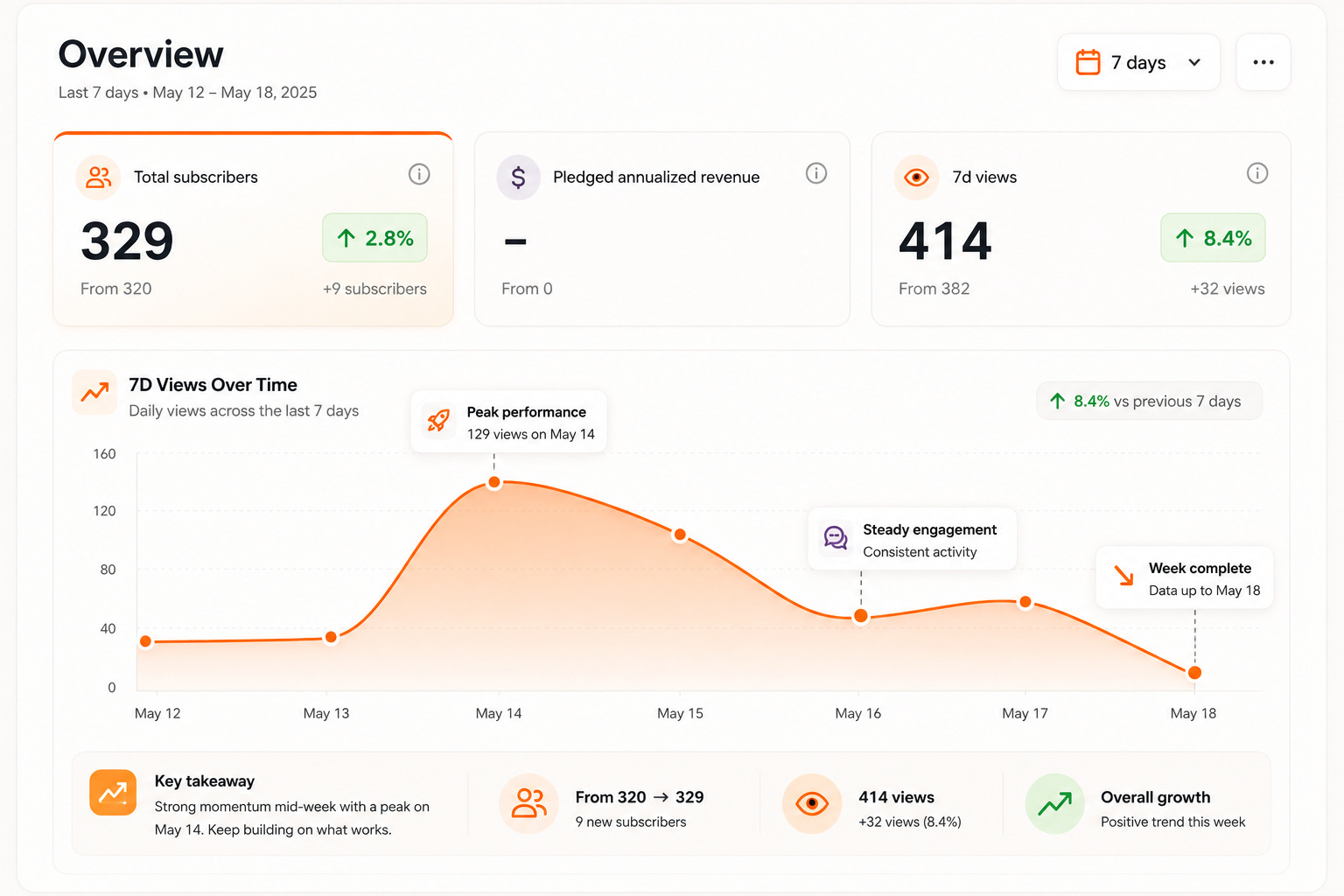
Over the last 7 days:
Subscribers: 320 → 329
Views fluctuated heavily throughout the week
Growth still continued quietly underneath the surface
That mattered more psychologically than I expected.
Because for the first time I could actually see patterns.
Not guesses.
Patterns.
Some high-view days produced almost no subscriber growth.
Meanwhile quieter days still brought subscribers later.
That happened repeatedly.
And honestly, that completely changed how I think about creator productivity.
Because I realized I had been reacting emotionally to noise instead of paying attention to signals.
Quiet growth is real.
People read quietly.
Think quietly.
Then subscribe later.
And once I started seeing that clearly, something unexpected happened:
the panic reduced.
Not because growth suddenly became easy.
But because my brain stopped trying to interpret every single day like a final verdict on my ability as a creator.
What MAP Actually Started Solving
That is part of why I started building MAP differently.
Not as another analytics tool.
Not as a productivity hack.
Mostly because I realized I could not trust my emotional perception of progress anymore.
So instead of reacting emotionally to every quiet day online, I started tracking:
Notes posted
conversations started
comments left
profile visits
delayed subscribers
patterns over time
And honestly, the data kept revealing something surprising:
quiet consistency was outperforming emotional perfectionism.
Some posts I barely edited brought subscribers days later.
Some heavily polished posts did almost nothing.
Some comments quietly converted later in the week.
That changed the way I worked completely.
Because once I could actually see patterns clearly, the panic reduced.
Not because growth suddenly became easy.
But because my brain stopped trying to interpret every single day like a final verdict on my ability as a creator.
The Shift I’m Starting To Believe
If you simply “set your mind to it,” you can sometimes force yourself forward temporarily.
But if you build a system with clarity, you can keep moving even when emotions fluctuate.
Honestly, that mindset shift is the only reason I’ve been able to keep balancing:
a job
completing my BSc
building a digital product
learning tech
writing consistently online
Because the truth is:
24 hours are not enough for anyone trying to build something meaningful.
Which means the real problem is usually not effort.
It is friction.
Too many unclear decisions.
Too much emotional noise.
Too many invisible feedback loops draining attention.
That is the part MAP started helping me reduce.
Not by making me “more motivated.”
But by helping me finally see:
what actually matters
what quietly compounds
and what only feels urgent emotionally
And honestly, once you can see your patterns clearly, publishing starts feeling lighter again.
Not because fear disappears completely.
But because uncertainty stops controlling every decision.
I’ve been walking through this system during small MAP workshops and showing exactly what I track, what starts becoming visible over time, and how the emotional pressure reduces once the guessing stops.
And if you’re under 100 subscribers constantly rewriting things before the audience even exists yet… this might help.
Here’s How to Set Up MAP
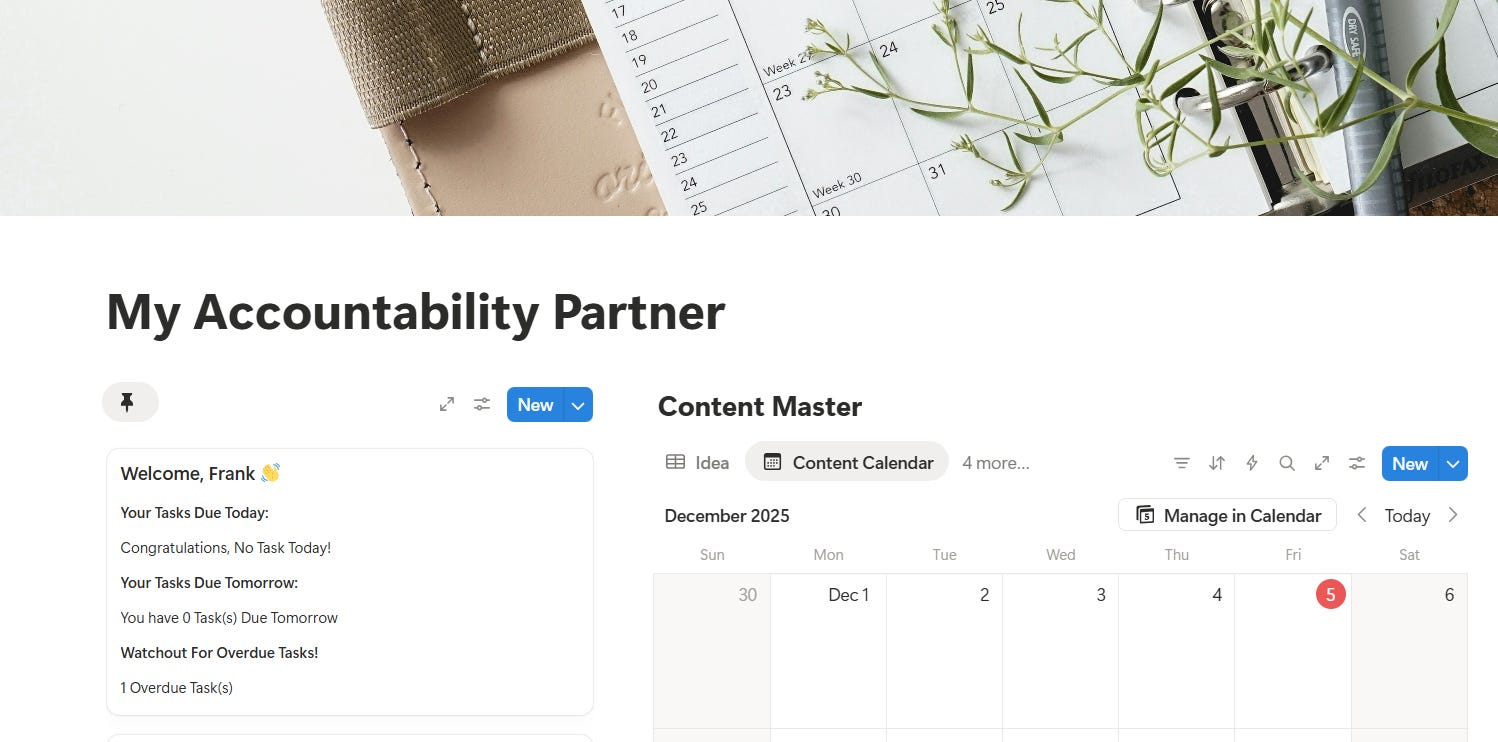
If you’ve been stuck in that cycle of checking stats, changing direction, and second-guessing yourself every week, this is the system I’ve been using to reduce the noise and actually see what’s happening clearly.
Then enter $20 on Gumroad to access the workspace and duplicate it into your Notion account.
After that, you start posting, tracking, and reviewing your patterns weekly.
That’s it.
No complicated dashboards. No growth hacks. No trying to “beat the algorithm.”
Just a clearer way to see:
what’s actually helping
what’s wasting your energy
and what keeps quietly compounding even when growth feels invisible
And honestly, once you can see your patterns clearly, the emotional chaos starts reducing too.
 | A guest post by
|
Frank, this was really, really good. Honestly, one of the most relatable things I’ve read lately about writing online. I think you nailed something a lot of creators quietly struggle with but don’t always admit, how easy it is to convince ourselves we’re “working” when really we’re just hiding in editing and overthinking.
And Shah’s section too… ooof. That whole idea of perfectionism being fear dressed up as quality control? Yep. Felt that. 😅
I also really appreciated the part about quiet growth. I think so many of us emotionally react to every single post, every dip, every quiet day, like it means something huge about us as writers or creators. Seeing you frame it more as patterns over time instead of daily emotional chaos honestly felt grounding.
And thank you for featuring my words in this. That last line still hits me too, because I really do think so much of over-editing is us trying to protect ourselves more than the work itself.
This is great. It normalized my own process and that is really affirming. I will check out MAP